Your documentation says one thing. Your team does another.
As the project grows, documentation breaks. Strudo structures it in typed blocks by department and priority so the whole team works from the same truth.
The individual plan is free forever.
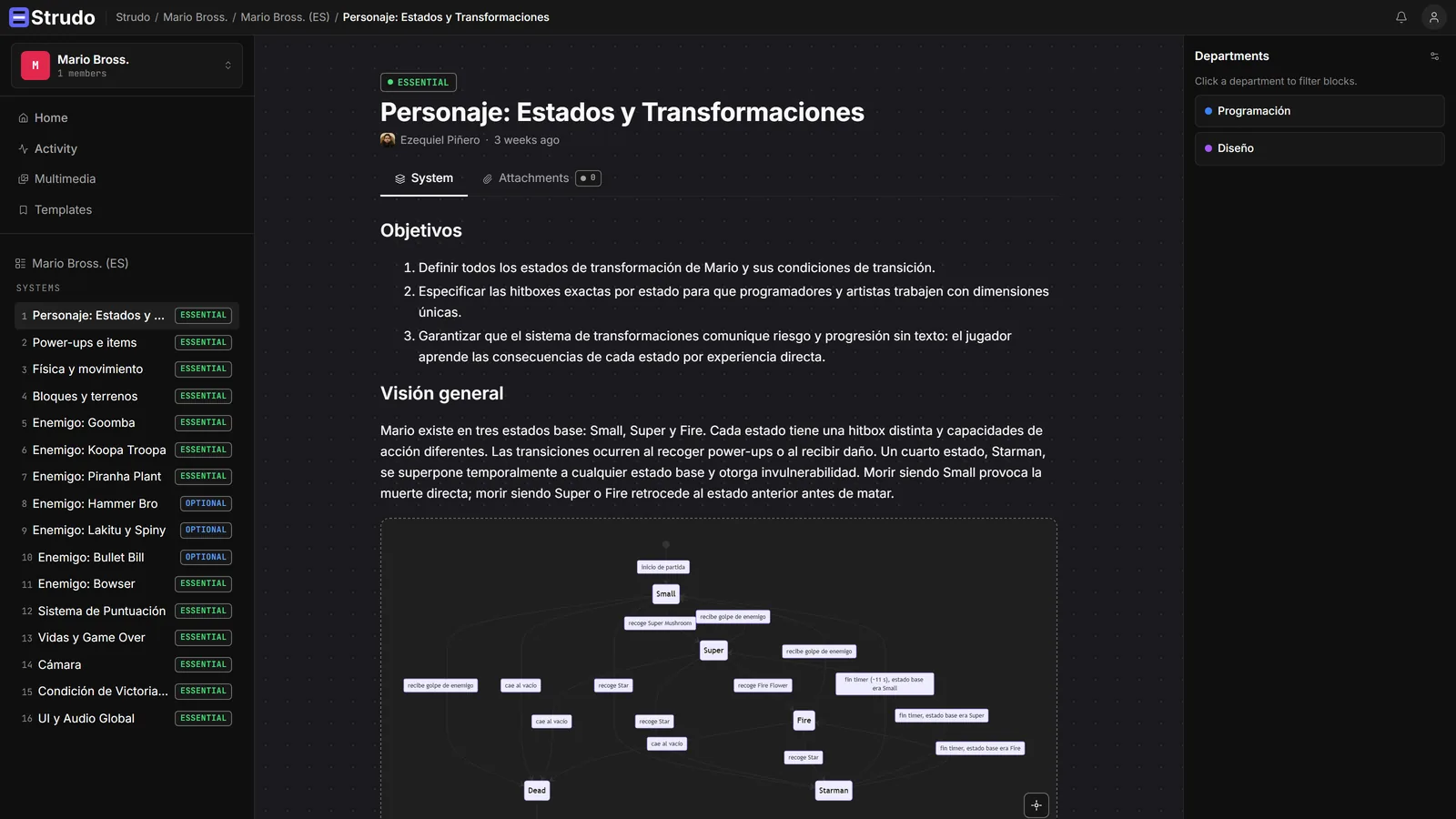
Explore Strudo with a real
game design document
Documentation that works in pre-production breaks in production.
In pre-production everything seemed under control. A central document in one tab, spreadsheets with technical values, visual references scattered across shared folders. But production always comes.
The documentation is 40 pages long and nobody knows what's approved, what was cut last sprint, or what changed last week. The programmer needs specific data and it's in a spreadsheet only the designer has. The artist is preparing assets for a system that was already redesigned. The director asks what makes the next milestone and nobody has a quick answer.
The team stops checking the document because it's probably outdated. And when they stop checking it, it falls out of date even faster.
One simple question. Four sources. Three different answers.
Documentation that can't be misread.
Strudo replaces endless pages of free-form text with specialised blocks. A balance table is a balance table, not a paragraph each department reads differently. A state diagram is an interactive diagram, not an exported image you have to redo every time something changes.
Typed blocks
Attributes, formulas, dialogues, controls, state diagrams, balance tables. Every block has a type that removes the ambiguity of free-form text. 24 special block types designed for production documentation.
Department filtering
Each block is assigned to one or more departments. Each team member filters and sees only what's relevant. Leadership keeps the full picture. Zero noise, zero confusion about who owns what.
Block priorities
Essential, Optional, Future, DLC. Every system in the project has a visible priority level. The team knows what's critical for the next milestone, what gets cut if time runs short, and what's saved for later.
Built from the pain.
Strudo was born from the frustration of documenting a project with four different tools. One for writing, another for diagrams, another for flows you export as an image and paste into the document. Two hours of work that's worthless next week because the system changed.
The individual plan is free forever. No card, no time limit.
Create your account and start documenting your first project in minutes.